
Introduction

sched_ext is transforming Linux kernel scheduler development with its extensible, BPF-powered approach. Since its inception as an RFC, it has grown into a diverse ecosystem spanning custom schedulers, user-space tooling, and production-ready components. This article provides a deep dive into the major scheduler classes, their unique design goals, and the management utilities powering the system.

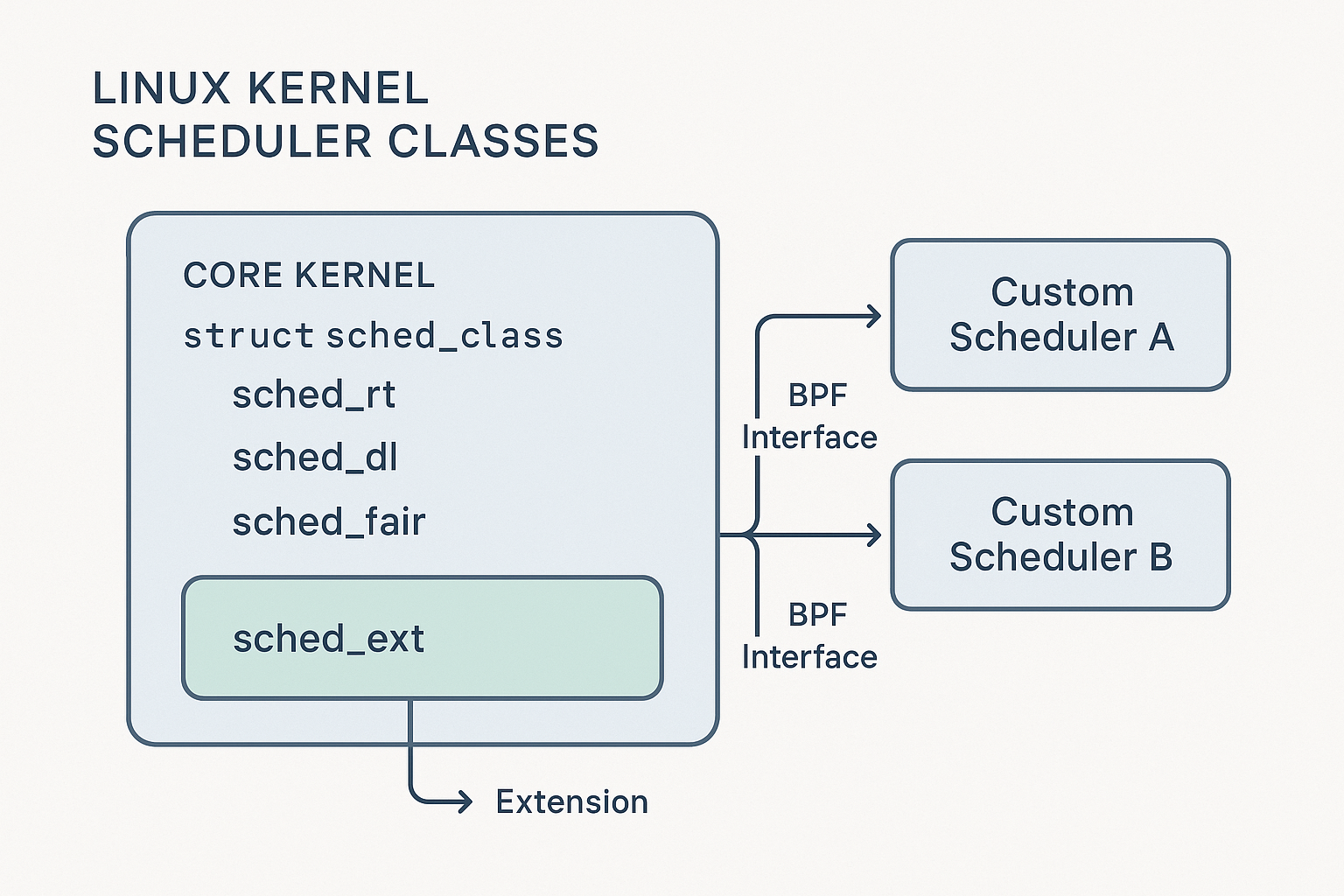
Here’s how sched_ext integrates with the kernel’s sched_class model, enabling pluggable, BPF-based scheduler modules:

Raghu Bharadwaj

Known for his unique ability to turn complex concepts into deep, practical insights. His thought-provoking writings challenge readers to look beyond the obvious, helping them not just understand technology but truly think differently about it.

His writing style encourages curiosity and helps readers discover fresh perspectives that stick with them long after reading

Categories of sched_ext Schedulers

The ecosystem features a rich variety of schedulers. They are grouped below by core use case and derived architectural principles:

Demonstrative and Foundational

General-Purpose

Gaming & Low-Latency

Hybrid & Experimental

Management Tools

To coordinate and automate the usage of schedulers, the following tools are central:

Summary

The sched_ext ecosystem represents a leap forward in kernel scheduling: it offers depth through its novel BPF-driven extensibility, breadth through its range of schedulers, and usability via standard tooling. Whether in research, gaming, or datacenter production, workload-specific scheduling has never been more practical or accessible.

Recent Posts