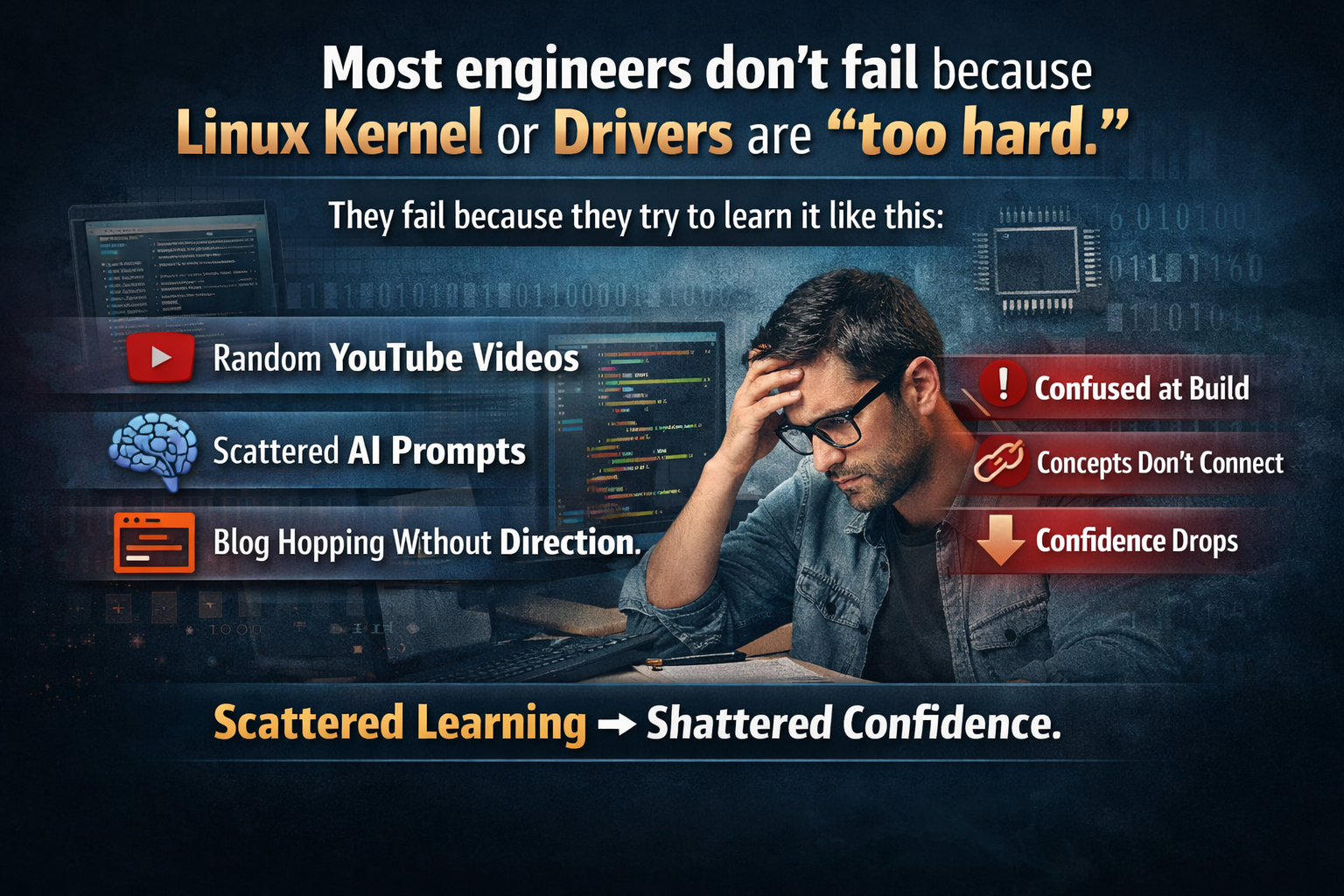
Let’s get one thing straight: Learning Linux drivers or any core concepts like Kernel programming or Linux systems programming is not like learning a set of APIs or understanding some random concepts, it is much more than what you see and learn at the surface.
Complex code, abstract concepts and systems you can’t “see” can simply tire and confuse you and this is exactly where most engineers give up.
The real question you should be asking yourself is:
-
What are the necessary foundational skills that I should know before I start learning?
-
Do I have the necessary mindset and approach to understand these deeper aspects?
-
More than what I read/listened/watched today, should I be worrying about what exactly I added to my current understanding?
-
Did I build on my existing knowledge or is this completely new?
Remember that advanced systems cannot be rushed, there is a particular roadmap: punctuated with understanding, reflecting and relearning aspects which will help you build a concrete understanding
Another key aspect is for you to have a feedback loop, like when you’re stuck, there’s someone like a mentor to guide you through and accelerate your learning. You should have some source to:
This support from some authority will help you stay on track and not wander away from the path
Here are few tips to help you stay on course:
- Slow Down to Speed Up
Stop trying to cover topics quickly and randomly
Instead:
Depth beats speed—every single time.
2. Think in Systems, Not Topics
Most of these concepts are connected and unless you start thinking about it as a whole system and not as individual topics you will not get the macro level perspective
3. Ask Better Questions
Every time you get confused or run into some error, ask:
-
Is this concept new, or do I lack the necessary understanding to learn this?
-
Am I guessing here?
-
Why did this program fail, let me trail the execution path and see?
These questions train your mind to think like an engineer.
4. Build a Daily Learning Habit
Not motivation. Not bursts. Just pure Consistency. Even 60–90 minutes of focused effort daily is enough—if done right.
5. Embrace Struggle as Progress
This is important. If you feel: Confused, Slow and Stuck you’re not failing. You’re finally learning something real.
6. Learn With Guidance (Not in Isolation)
Self-learning doesn’t mean learning alone. Having a structured path, a mentor and real-world explanation can reduce months of confusion into clarity.
Final Thought
Most engineers don’t fail because Linux drivers are too hard. They fail because: they try to learn it the same way they learned everything else, but this is different. This requires patience, depth and systems thinking and once you cross that barrier you don’t just learn Linux, you start thinking like a systems engineer.
If you wish, we can guide you with a structured and well-established learning process to help you gain a deeper understanding of Linux device drivers
Keep Learning,
Team TECH VEDA